Theory of Change
From Understanding Coral Life to Transforming Reef Futures
We cannot fundamentally change the trajectory of coral reefs until we change how we understand, investigate, and intervene in coral health. By making coral biology experimentally accessible at the cellular and molecular levels, we can move from reacting to coral decline toward understanding, predicting, and ultimately influencing the biological processes that determine coral survival.
Understanding the mechanisms of coral resilience creates possibilities for action that we cannot currently imagine, let alone implement.
The problem we are tying to solve
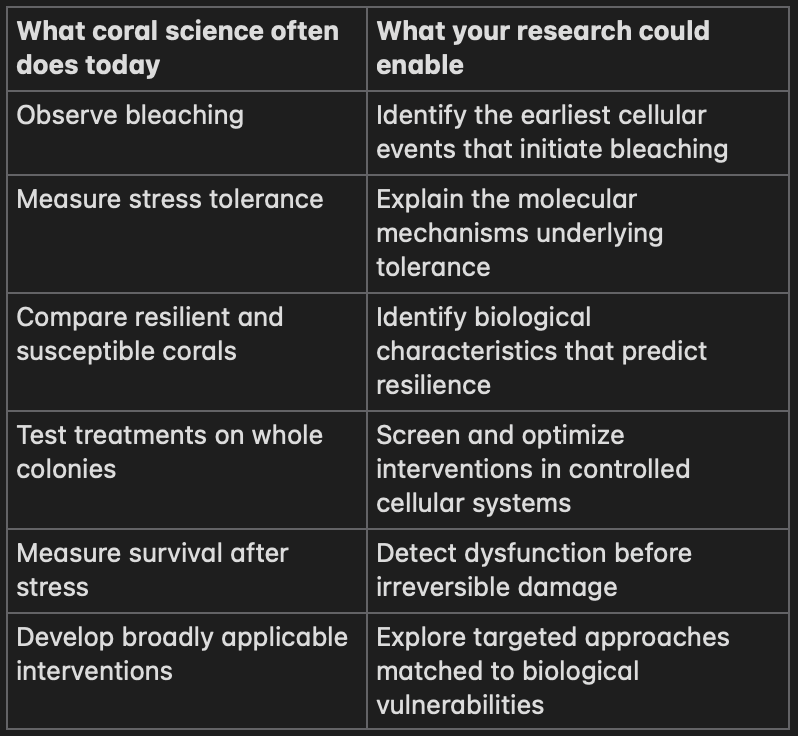
Much of coral reef science operates at two ends of the spectrum. At one end, we document environmental change, bleaching, mortality and ecological decline. At the other, we develop interventions: restoration, assisted evolution, probiotics, selective breeding, and other approaches intended to improve coral survival. But between those two sits an enormous biological knowledge gap.
We often know what happens to corals without understanding precisely how and why it happens.
We can measure bleaching, but we still struggle to establish the causal sequence of cellular events that leads to symbiosis breakdown.
We can identify stress-tolerant colonies, but we often cannot explain what makes them tolerant.
We can propose treatments, but we lack many of the experimental systems needed to understand their mechanisms, predict their effects, or optimize their delivery.
Our work is trying to address these gaps.
Central hypothesis about change
If we make the cellular and molecular machinery of coral health experimentally accessible, then we can uncover the mechanisms governing resilience, develop predictive indicators of vulnerability, and design interventions that are mechanistically informed.
Five interconnected components of our Theory of Change
I. Make the invisible accessible
Develop the experimental systems, analytical tools, and molecular methods needed to study coral biology at previously inaccessible levels.
This includes your primary cell cultures, symbiocyte models, molecular assays, imaging approaches, and emerging genetic manipulation capabilities.
Change created: Coral biology becomes increasingly amenable to controlled, mechanistic experimentation.
II. Replace correlation with causation
Use these platforms to identify how environmental disturbances are sensed, transmitted, amplified, or buffered within coral cells and their symbiotic partners.
Your work on calcium signaling, oxidative stress, heat-shock proteins, insulin signaling, and symbiosis fits here.
Change created: We move from describing stress responses to identifying mechanisms that actually determine biological outcomes.
III. Turn mechanistic knowledge into predictive power
Once we understand the biological pathways involved in stress tolerance and symbiotic stability, we can begin identifying early indicators of dysfunction.
This is where your interest in personalized or precision medicine for corals becomes especially compelling.
Change created: Coral health assessment shifts from detecting damage to anticipating vulnerability.
IV. Turn prediction into intervention
Mechanistic understanding can guide the development of more targeted approaches to improve coral health.
Your work with nanotechnology, molecular delivery, and cellular rescue sits within this component.
The objective is not necessarily to treat every coral individually. It is to discover which biological processes are modifiable and which interventions have a realistic prospect of improving resilience.
Change created: Coral interventions become increasingly rational, targeted, and testable.
V. Transform how coral science is conducted
This is the component that I think distinguishes your ambitions from those of many individual coral biologists.
Your vision for interdisciplinary research, new experimental infrastructure, collaborative institutes, and scientific training is not peripheral to your theory of change.
It is part of the mechanism.
You recognize that coral reef science cannot fully exploit advances in molecular biology, biochemistry, biotechnology, and medicine while remaining organized around traditional disciplinary boundaries.
Change created: An interdisciplinary research ecosystem capable of generating discoveries and solutions that no single discipline could deliver.
We believe that transforming the future of coral reefs requires transforming how we study coral health.
The goals is not simply to develop better tools to save corals. it is to create the scientific foundation that makes entirely new approaches to coral conservation possible.